



Team Members: Dr.M.Krishnaveni, CMLI Co-coordinator, Assistant Pofessor(SG), Departemnt of Computer Science.
Ms.Aanisa S, Technical Assistant , CMLI.
Ms.Sowndharya B, III B.Sc. CS.
Ms.Sruthi M, III B.Sc. CS.
Project Summary:
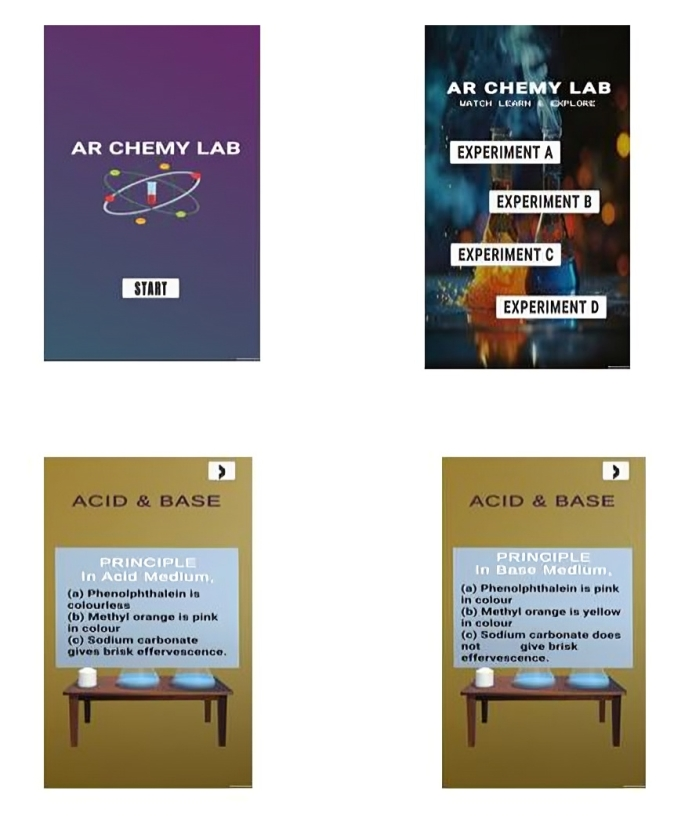
The integration of Augmented Reality into school education chemistry practical revolutionizes learning by addressing safety, accessibility, and engagement challenges. AR enables students to simulate hazardous experiments, reducing risks and providing access to activities limited by infrastructure or resources. Through 3D visualization, AR helps students understand complex chemical processes, and reaction mechanisms. It fosters an interactive and immersive learning environment, enhancing engagement, motivation, and retention of knowledge while encouraging exploration beyond traditional curricular.AR applications offer instant feedback, allowing students to learn from mistakes in real-time and practice experiments without material constraints. Collaborative features promote teamwork and critical thinking through group activities and discussions. Practical applications include virtual acid-base titrations, salt analysis, molecular bond visualizations, and. Using smartphones, tablets, or AR goggles, students can interact with virtual lab equipment and observe chemical phenomena vividly and safely. This study explores the integration of augmented reality in chemistry labs using Unity software, aiming to enhance interactive learning experiences by simulating and laboratory experiments in an immersive virtual environment. By integrating AR, educators create a cost- effective, engaging, and safe learning environment, bridging the gap between theory and practice while inspiring interest in chemistry and STEM fields.