


Team Members: Dr.P.Subashini, CMLI Coordinator,Professor of Computer Science.
Dr.M.Krishnaveni, CMLI Co-coordinator, Assistant Pofessor(SG), Departemnt of Computer Science.
Dr.G.T.Prabavathi, Associate Professor of Computer Science, Gobi Arts and Science College.
Ms.E.Rathipriya,Technical Assistant,CMLI.
Ms.M.Esaivani, Teaching Assistant,CMLI.
Mr.Muralitharan J, II MCA , Gobi Arts and Science College.
Project Summary:
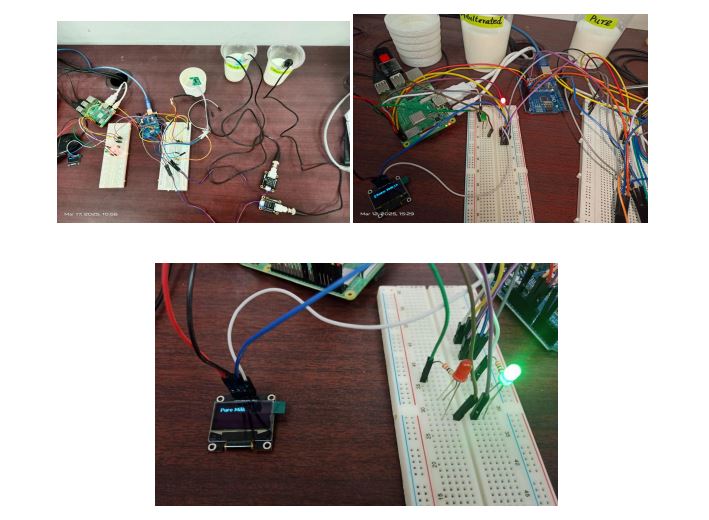
Milk is a crucial component of daily nutrition, yet its quality is frequently compromised due to adulteration. Existing detection methods are large, involving complex laboratory procedures that are slow and inefficient. These methods lack real-time monitoring capabilities, making them ineffective for large-scale dairy industries and distribution chains. The delay in detecting adulteration increases the likelihood of contaminated milk being consumed, leading to serious health risks. To overcome these challenges, a real-time automated system is necessary. The proposed system integrates IoT sensors and machine learning to enable real-time milk quality monitoring. This approach eliminates the limitations of traditional chemical testing, offering an efficient, cost-effective and accessible solution. The system continuously monitors milk properties using IoT-based sensors and classifies milk as pure or adulterated using a Decision Tree algorithm. The results are displayed instantly on an OLED screen, ensuring immediate feedback. If adulterants are detected, the system identifies the type of adulterant and determines the overall toxicity level. Additionally, an LED indicator provides a visual alert for adulterated milk, while the collected sensor data is stored and analyzed on the ThingSpeak cloud dashboard for remote monitoring. 3 The primary objective of this project is to ensure milk quality and safety by implementing a real-time adulteration detection system using IoT sensors and machine learning. The system aims to replace traditional, labor-intensive chemical testing with an automated and instant detection method, providing more efficient and accurate results. By integrating advanced sensing technology, the system can detect specific adulterants such as sodium bicarbonate, detergent, excess water, urea and formalin. Additionally, temperature sensors are employed to monitor deviations that may indicate contamination, further enhancing the accuracy of the detection process. To assess milk safety comprehensively, the system analyzes the concentration levels of adulterants and determines overall toxicity, enabling both consumers and regulatory authorities to take preventive actions against contaminated milk. This feature is crucial in mitigating potential health risks associated with milk adulteration. The system also offers real-time monitoring capabilities by displaying test results instantly on an OLED screen, allowing users to make informed decisions. Moreover, an LED indicator provides a visual alert when adulteration is detected, ensuring quick identification of unsafe milk. To enhance accessibility and usability, the system is integrated with ThingSpeak, a cloud-based platform that enables remote data storage and real-time monitoring. This ensures that dairy farms, milk collection centers and processing units can efficiently track milk quality from any location. Additionally, the system is designed to be cost-effective, reducing dependency on expensive laboratory-based chemical testing while offering a scalable solution for large-scale dairy operations. By automating the detection process, this system significantly improves efficiency, eliminates human error and ensures a reliable and consistent approach to milk adulteration detection. The system consists of multiple IoT sensors, including a pH sensor, conductivity sensor and temperature sensor, formaldehyde sensor that continuously measure milk properties. The collected data is processed using a Decision Tree machine learning algorithm, which classifies milk quality with high accuracy. The OLED display provides instant results, while the LED indicator serves as a quick alert mechanism. Integration with ThingSpeak enables remote monitoring, allowing stakeholders to track milk quality from any location. The automation of this process reduces human intervention, improving efficiency and reliability while eliminating dependency on complex laboratory testing. 4 This advanced detection framework enhances milk quality assessment, facilitates real-time monitoring and ensures better consumer protection by enabling early detection of contaminants. By leveraging IoT and machine learning, this approach provides a scalable and efficient solution to detect adulteration and maintain milk safety. The proposed system eliminates the need for extensive chemical testing, reducing time and cost while enhancing accuracy. As food safety regulations become more stringent, such smart detection systems will play a crucial role in maintaining milk purity and ensuring consumer safety.