



 Translate
Learner Centric Education
NHEQF & NCrf
The institution has effectively implemented the National Education Policy (NEP) 2020 by developing curriculum frameworks for all undergraduate programmes in alignment with the National Higher Education Qualification Framework (NHEQF) and the Learning Outcome-Based Curriculum Framework (LOCF) prescribed by the UGC.
The institution has successfully implemented the LOCF-based curriculum across 45 Undergraduate and 43 Postgraduate programmes under the Choice Based Credit System (CBCS) within four and eight Framework Models
The curriculum has been structured based on four models of the Conceptual Framework for Undergraduate Programmes, applicable from the academic year 2023–2024 onwards.
Link to the Academic Council:
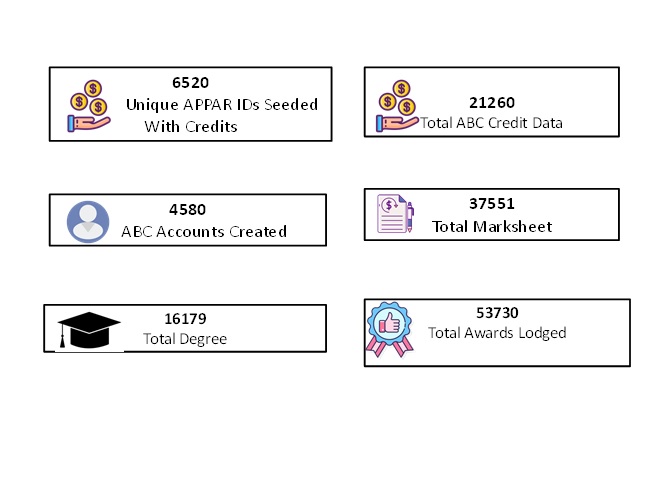
Academic Bank of Credits (ABC)
Registration
This Institute had registered for ABC in the National Academic Depository on 08.02.2022 (ABC0035491644320809)
UGC - NAD Digilocker
UGC – NAD Digilocker User Creation and Certificates downloading procedure
Report as on 19th February 2025
Multiple Entry and Exit
All Postgraduate programmes of the institution are designed with NEP-compliant multiple entry and exit options, supported by the Academic Bank of Credits (ABC) to provide flexible learning pathways and enhanced mobility for learners.
In alignment with the National Curriculum and Credit Framework (NCrF), the following four B.Voc programmes are offered with multiple entry–exit provisions:
SEDG’s (Socio-Economically Disadvantaged Groups)
The University has adopted the UGC “Guidelines to Provide Equitable Opportunity for Socio-Economically Disadvantaged Groups (SEDGs) in Higher Educational Institutions” (F.No.6-2/2022/Part 2, dated 02.01.2024), aligning with the vision of the National Education Policy (NEP) 2020. These guidelines support India’s commitment to the Sustainable Development Goals (SDGs)—particularly SDG-4 (Quality Education), SDG-5 (Gender Equality), SDG-1 (No Poverty), and SDG-8 (Decent Work and Economic Growth)—by ensuring equitable access, safety, and academic support for all learners.
The Executive Council of the institution (Item No. 17, 133rd EC/2024/17) has formally approved and implemented these guidelines, strengthening our commitment to inclusive and equitable higher education
Institutional Initiatives
- Ensured inclusive access with 41% first-generation learners, 62% economically and socially challenged students, and 42% rural students in total enrolment.
- Established a dedicated SEDG Cell as per UGC Guidelines to promote equity, safety, and academic support for disadvantaged groups.
- Created fully functional SC/ST/OBC/Minority/PwD Cells, offering remedial coaching, bridge courses, and specialised support through a Special Education Department and Early Intervention Centre for learners with special needs.
- Implemented the UGC Guidelines on Basic Facilities and Amenities for a Safe and Secure Environment for Women, supported by an active Women’s Cell responsible for sensitisation programmes, policy enforcement, monitoring, and grievance redressal. These efforts have been further strengthened through a comprehensive Safety and Security Audit of the entire campus.
- Conduct regular safety, disaster management, and emergency preparedness sessions for students and staff, guided by the institution’s Disaster Risk Management Policy to ensure resilience and safety across the campus.